If you’ve ever brought a parent home after a hospital stay, you know the real work often starts after discharge. The hospital did its part—but now the family is staring at a new reality: medication changes, follow-up visits, fall risks, fatigue, confusion, appetite loss, mobility challenges, and that constant worry at night: “What if something happens while I’m asleep?”
That’s why we’re proud to share a major milestone from our team at A Place At Home – Schaumburg:
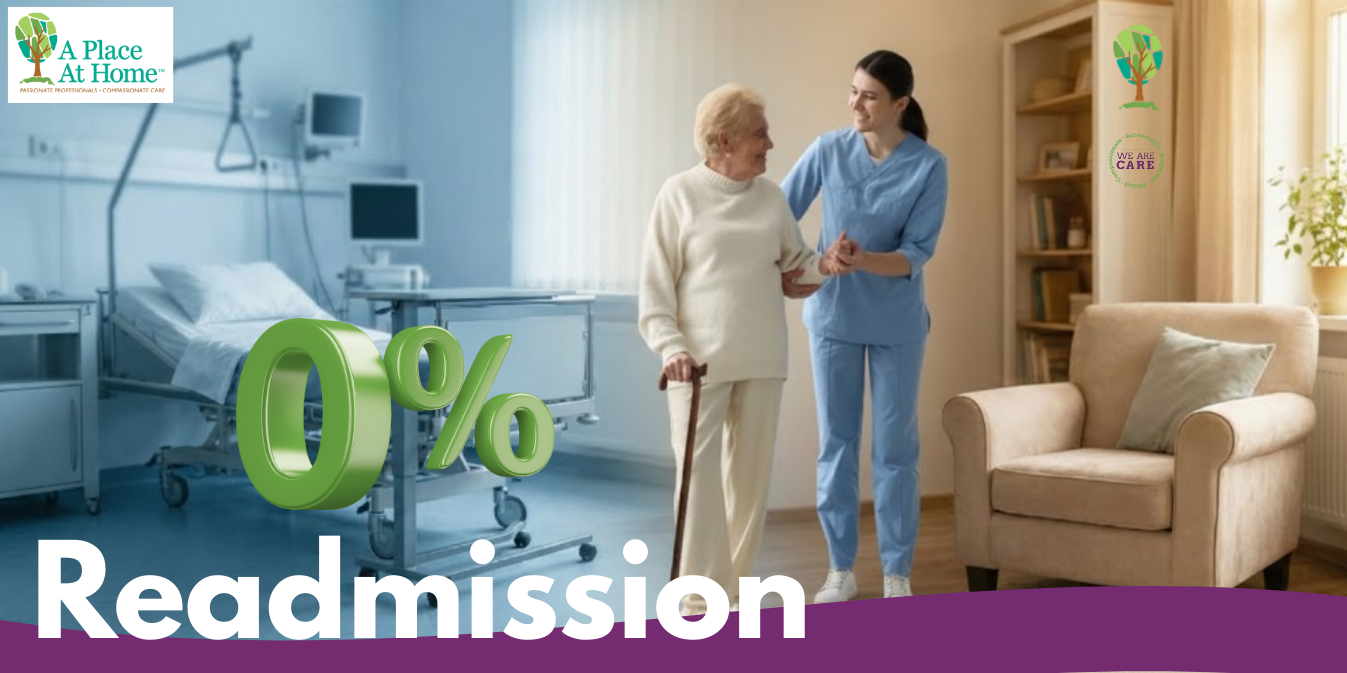
In 2025, we supported 61 clients, built long-standing relationships with an average client tenure of 20 months, and achieved 0% 30-day readmissions, with an overall hospitalization rate of just 1%— helping seniors stay safer at home through consistency, compassion, and experienced caregiving.
This isn’t just a number. It’s fewer emergency trips. Fewer setbacks. More stable recoveries. More families able to breathe again.
Why 30-day readmissions matter so much (and why they happen)
A “30-day readmission” means a senior ends up back in the hospital within 30 days of discharge. Across the healthcare system, this window is widely recognized as the most vulnerable period after hospitalization.
Readmission rates vary by condition and how they’re measured, but research has reported 30-day readmission rates ranging roughly from 11% to 23% among elderly Medicare beneficiaries. PMC
Why are readmissions so common for older adults? Because recovery isn’t just clinical—it’s practical. Seniors are healing while also navigating real-world obstacles:
- New medications (or dose changes) that are confusing or cause side effects
- Weakness, dizziness, balance issues, or fall risk
- Missed follow-up appointments due to transportation or scheduling gaps
- Poor sleep, dehydration, low appetite, and malnutrition
- Cognitive challenges (including delirium after hospitalization, dementia, or “sundowning”)
- Lack of consistent support at home—especially overnight
And a big one: the discharge process is often overloaded with instructions that are hard to absorb in one day. Studies estimate that about 20% of patients experience adverse events after discharge, often medication-related, and many are preventable or could be reduced. NCBI
So when we talk about “preventing readmissions,” we’re really talking about protecting the recovery period at home—where small misses can turn into big emergencies.
What “0% 30-day readmissions” means at A Place At Home – Schaumburg
Let’s be clear and responsible: this does not mean no one will ever be readmitted. Healthcare is complex, and no service can guarantee outcomes for every individual.
What it does mean is this: based on our 2025 client outcomes tracking, the seniors we supported did not experience a hospital readmission within 30 days of discharge—and our overall hospitalization rate was extremely low.
That’s a reflection of a simple truth we see daily:
Great caregiving isn’t written on paper—it’s lived.
It’s the right eyes on the right details, at the right time.
How we achieved it: trained, experienced caregivers + consistent follow-through
At A Place At Home – Schaumburg, our biggest strength is our team: trained, experienced caregivers who understand what recovery looks like in the real world. They don’t just “help”—they observe, document, communicate, and escalate early when something feels off.
Here’s the practical playbook behind outcomes like ours:
1) Consistency that reduces “care gaps”
When too many different hands rotate through care, details get missed. Consistent caregiving means patterns get noticed:
- “She’s not eating like yesterday.”
- “His breathing looks different today.”
- “This new med is making her dizzy.” Those early signals matter.
2) Medication support that reduces preventable problems
We don’t manage or prescribe medications—that’s clinical. But we support safety through:
- Medication reminders aligned with the discharge plan
- Observing possible side effects and reporting concerns to the family/clinical team
- Helping prevent missed doses, double doses, and confusion—especially when regimens change
Medication-related issues are a known driver of readmissions in older adults. NCBI+1
3) Fall prevention and mobility support
Falls after discharge can restart the entire hospital cycle. Our caregivers focus on:
- Safe transfers (bed to bathroom, chair to walker, etc.)
- Mobility assistance aligned with the family’s plan and therapist recommendations
- Home safety habits: lighting, pathways, clutter reduction, proper footwear
4) Nutrition + hydration support (the “silent risk”)
Dehydration and low intake can spiral quickly in older adults—especially post-hospital. Caregivers help by:
- Encouraging hydration throughout the day
- Supporting meal preparation and gentle appetite routines
- Noticing warning signs like weakness, confusion, or low energy
5) Follow-up logistics and recovery routines
A missed follow-up is a common failure point. We help families stay organized with:
- Appointment reminders
- Transportation support (when applicable)
- Routine-building so the home environment supports recovery, not chaos
Follow-up care soon after discharge is repeatedly associated with fewer readmissions. JAMA Network+1
6) Communication that keeps families informed (and faster to act)
Families shouldn’t have to guess what’s going on. Proactive updates help prevent “waiting too long” when something changes.
In our world, communication is a safety tool.
The 30-Day Safety Playbook (what families can use today)
If you’re caring for a loved one right now—whether you work with us or not—here’s a practical checklist to reduce the risk of a bounce-back:
- Confirm a clear medication list (what changed? what stopped? what’s new?)
- Schedule follow-ups before you leave the hospital (primary care + specialists)
- Create a “first 72 hours” plan (meals, hydration, bathroom safety, rest)
- Remove trip hazards and improve lighting (especially bedroom → bathroom path)
- Watch for red flags: confusion, dizziness, shortness of breath, fever, sudden weakness
- Keep a simple daily log: sleep, appetite, mobility, mood, bathroom patterns
- Don’t wait—call the doctor early if something feels off
And of course: if there’s an emergency, call 911.
A message to families in Schaumburg and Cook County
If you’re feeling stretched thin, you’re not alone. Most adult children aren’t just managing a parent’s care—they’re juggling work, kids, and life.
Our mission at A Place At Home – Schaumburg is to help seniors age in place with dignity, and to help families stop feeling like they’re carrying everything on one pair of shoulders.
Want support after a hospital stay—or exploring 24-hour care?
If your loved one is high-risk (falls, dementia changes, mobility decline, post-surgery weakness), the right in-home support can make the difference between a steady recovery and a painful bounce-back.
Reach out to our team for a conversation. We’ll listen, understand the situation, and map next steps—clearly and compassionately.
Office Address:
990 Grand Canyon Suite 220
Schaumburg, IL 60169
Contact Details:
+1 773 808 7881 /
+1 630 599 8939
Email Address:
schaumburg@aplaceathome.com
Because the best care isn’t a promise. It’s what happens on ordinary days, when nobody’s watching—except a trained caregiver who knows what to look for.